An active, diversified, multi-sector approach to meeting the total return objectives of core fixed-income management without taking on undue risk.
Introduction
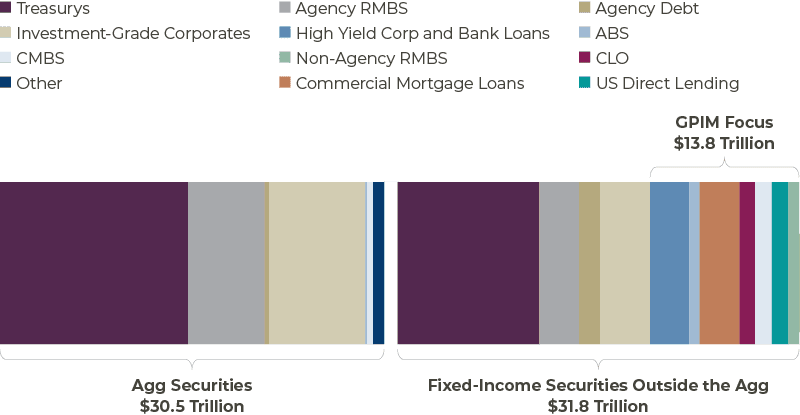
The U.S. fixed-income market offers some of the best income opportunities in decades. Yet core fixed-income investors benchmarked to the Bloomberg U.S. Aggregate Index (Agg) are forgoing some of the most attractive risk-adjusted returns. As the fixed-income market has evolved, the Agg has lagged and now represents less than half of the investable universe. The index is also increasingly concentrated in government-related debt, especially Treasurys. We believe this leaves investors under-diversified and earning lower returns.
Investors tilting heavily toward investment-grade corporate bonds in an effort to overcome this concentration and boost returns may simply be replacing one form of concentration with another—increasing downside risk should spreads widen. At Guggenheim Investments, we believe a more efficient solution lies in actively managed, diversified portfolios that draw from both benchmark and non-benchmark sectors, including structured credit, private lending, commercial mortgage loans, and other assets that may offer attractive excess returns, strong structural protections, and stable income.
Report Highlights
- The Agg and strategies constrained by this benchmark overlook sectors that may offer stable and attractive excess returns to investors with the expertise to manage complexity.
- At $30.5 trillion, the Agg represents less than half of the total U.S. fixed-income universe, leaving out $31.8 trillion of non-indexed securities.
- A diversified and active investing approach can help unlock returns by investing across the fixed-income spectrum, including sectors not included in the Agg.
- At Guggenheim Investments, we believe in a disciplined strategy that combines active management within the benchmark and selective allocations beyond it—without sacrificing quality. Specialized credit markets typically offer yield premiums over benchmarked fixed income while still providing investors with better structural protections and stronger cash flow profiles.
SECTION 1
The Core Conundrum
With yields at historically attractive levels, fixed income represents one of the most compelling income-generating opportunities in years. Yet the benchmark that many investors rely on—the Agg—has become increasingly misaligned with the opportunity set. Its inclusion criteria have led to overconcentration in Treasurys and limited sector diversification. Credit spreads in many Agg categories are near historically tight levels, providing little cushion to help protect against adverse environments.
Accordingly, we believe investing solely in the indexed universe does not provide the best risk-return tradeoffs for investors. In our view, capturing fixed-income opportunities requires a more flexible approach that goes beyond traditional benchmarks to optimize both yield and risk management.
The Income Is Back in Fixed Income
Unique circumstances after the Global Financial Crisis helped keep Treasury yields below 3 percent for almost a decade. Below-target inflation, combined with a sluggish economic recovery, led the Federal Reserve (Fed) to maintain a prolonged period of near-zero policy rates and quantitative easing (QE).
Since the pandemic, however, higher quality fixed-income yields have returned to historically attractive levels, creating a compelling opportunity to enhance portfolio income. Yields may fluctuate with the business cycle but seem unlikely to return to the low levels of the previous decade. Current levels reflect more normal expectations for long-term growth, supported by solid U.S. fundamentals. From a longer historical perspective, today’s yield levels appear more typical than those of the post-2008 period. Absent a significant shock, we expect them to remain in this higher range.
The Income Is Back in Fixed Income
Benchmark Sector Yields Versus Their Historical Average
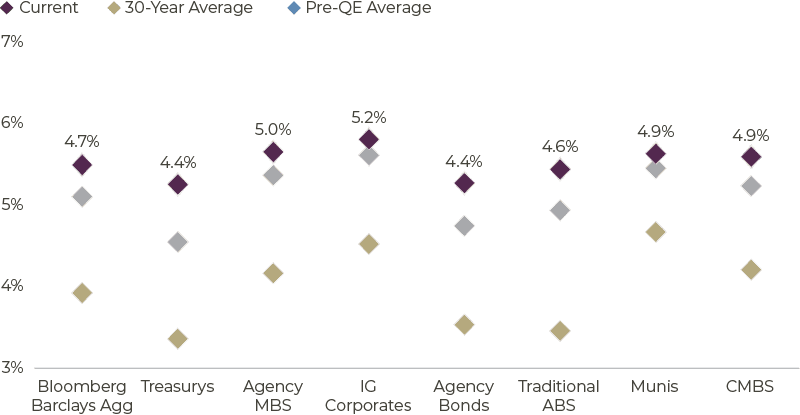
Source: Guggenheim Investments, Bloomberg. Data as of 6.30.2026. Index Legend: U.S. Treasurys: Bloomberg U.S. Treasury Index; Agency MBS: Bloomberg U.S. Mortgage Backed Securities Index; IG Corporates: Bloomberg U.S. Corporate Investment Grade Index; Agency Bonds: Bloomberg U.S. Government Bond Index; ABS: ICE BofA AA-BBB US Fixed Rate Asset Backed Index; Municipals: Bloomberg Municipal Bond Index; CMBS (Commercial Mortgage-Backed Securities): Bloomberg Investment Grade CMBS Index. Index information is provided for illustrative purposes only and is not meant to represent the performance of the strategy or its underlying investments. Past performance does not guarantee future results. Investing involves risk, and income is not guaranteed.
The Agg Fails to Capture the Breadth of Fixed-Income Market Opportunities
Even as overall yields offer higher income, investors relying solely on the Agg will miss the breadth of opportunities available in today’s fixed-income market. The Agg represents less than half of the investable fixed-income market, and strategies constrained by this benchmark overlook sectors that may provide attractive, stable excess returns and diversification for managers with the expertise to navigate the complexity.
The Agg Fails to Capture the Breadth of Fixed-Income Market Opportunities
The Bloomberg U.S. Aggregate Bond Index Represents Less than Half of the Fixed-Income Universe
Source: Guggenheim Investments, SIFMA, Bloomberg, JP Morgan Research, BofA Global Research, Mortgage Bankers Association. Data as of 12.31.2025.
Originally designed to represent the investment-grade fixed-income universe, the composition and risk profile of the Agg have lagged the evolution of the fixed-income landscape. The index includes only securities that are U.S. dollar-denominated, investment-grade rated (Baa3/BBB- or higher, using the middle rating of Moody’s, S&P, and Fitch), fixed rate, and taxable. The Agg also has minimum issue size requirements and excludes structured notes, which narrow its constituents to larger, less varied bonds.
These features limit inclusion at the expense of a broad range of fixed-income securities that can offer investors diversification and excess return potential. Key sectors underrepresented or entirely absent from the Agg include asset-backed securities (ABS), collateralized loan obligations (CLOs), residential mortgage-backed securities (RMBS), commercial mortgage-backed securities (CMBS), high yield bonds, commercial real estate (CRE) loans, leveraged loans, and private debt, as well as any floating-rate or tax-exempt securities. Importantly, the Agg excludes Rule 144A securities that lack registration rights, known as “144A-for-life” issuance, limiting its coverage of a large and rapidly growing segment of the fixed-income market. This exclusion has become increasingly material, as a meaningful share of AI- and data-center-related debt issuance has come to market in this 144A-for-life format, placing it outside the Agg even when investment grade. While investors may prefer not to concentrate exposure in a single theme, the Agg’s eligibility rules effectively remove that choice, precluding index-tracking investors from participating in this segment altogether rather than allowing them to create selective exposure.
The Agg Is Increasingly Concentrated in Treasury Securities
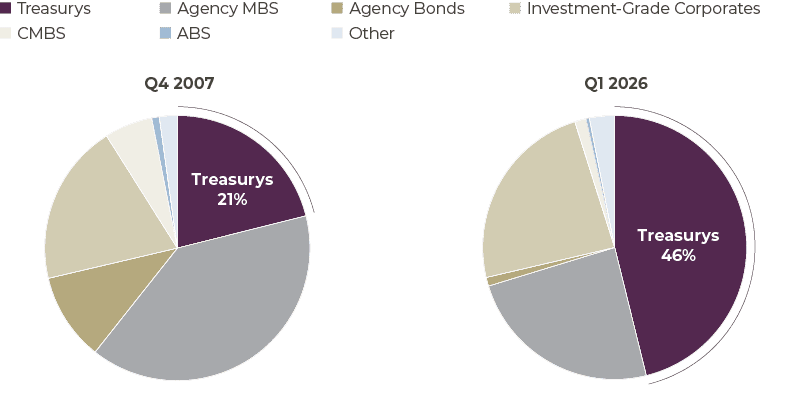
The sharp rise in the federal deficit since 2008 has reshaped the composition of the Agg by dramatically increasing the supply of U.S. Treasurys. Marketable U.S. Treasury securities have grown at an average annual rate of 10 percent since 2007, far outpacing the growth of nonfinancial corporate debt (5 percent) and financial institution debt (1 percent). As a result, the U.S. government has become the largest borrower in public bond markets. This shift has driven Treasurys’ share of the Agg from just 21 percent in 2007 to 46 percent today—concentrating duration and rate sensitivity in benchmark-constrained portfolios.
Treasurys Used to Be Less than a Quarter of the Agg. Today, They Represent 44% of the Agg.
Bloomberg U.S. Agg Index, by Sector, Dec 2007 and June 2026
Source: Guggenheim Investments, Bloomberg. Data as of 6.30.2026.
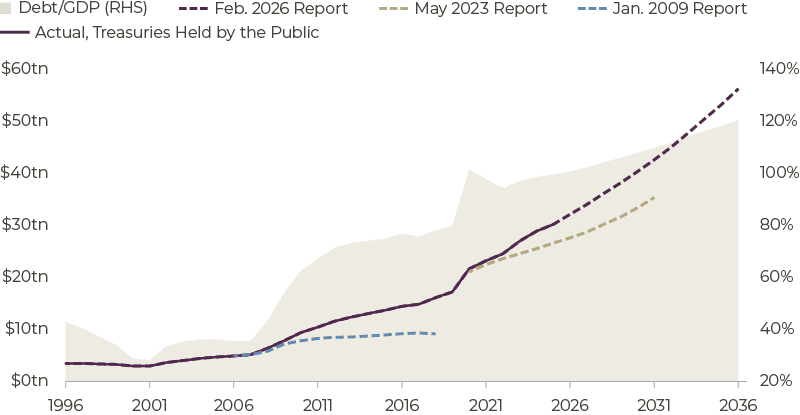
As Treasury issuance continues to grow, so too will the Agg, and index-constrained or passive funds will become increasingly overexposed. The Congressional Budget Office (CBO) projects Treasury debt outstanding to rise from $30 trillion today to $56 trillion by 2035, growing as a share of gross domestic product (GDP) from 99 percent to 120 percent. Historically, Treasury debt has at times grown faster than CBO projections, suggesting upside risk to these estimates. Structural fiscal pressures—including rising interest costs, mandatory spending programs, and the difficulty of enacting durable fiscal reforms—suggest Treasury issuance could continue expanding for years to come.
Rate volatility may become structurally higher, presenting another challenge for passive, long-duration investments. More frequent supply disruptions, rising fiscal pressures, and growing global investment needs could contribute to more frequent economic shocks, episodic inflation, and more variable monetary policy than experienced in the unusually low and stable policy rate period from 2010–2019. This environment increasingly favors active management.
Treasurys Outstanding Surged Post-2007 and Will Continue to Rise
Treasury Securities Outstanding in $Trillions
Source: Congressional Budget Office from an Update to the Budget and Economic Outlook: 2026 to 2036, published February 2026.
Opportunities Beyond the Benchmark
Fixed income plays an important role in the portfolios of long-term investors by providing steady income to match assets and liabilities, but the Agg alone may not provide the yield or diversification investors seek. Pension plan managers and other investors seeking to match long-term liabilities face challenges meeting high return requirements. The National Association of State Retirement Administrators reports that the median investment return assumption for national public pension plans is 7 percent, while life insurers typically target 5–6 percent for annuity products.
These targets are typically met with blended equity / bond portfolios, but they highlight the need for investors to achieve strong returns and broad diversification from fixed income. With its limited coverage of the fixed-income universe and concentration in government securities, the Agg is not meeting these requirements.
SECTION 2
Stretching for Yield to Overcome Agg Concentration
In seeking to overcome the benchmark’s inability to meet return or diversification needs, investors are increasingly overweighting higher yielding sectors within the index—particularly investment-grade corporates—and many are doing so through passive strategies. This introduces new vulnerabilities: increased exposure to lower rated credit, limited compensation for risk, and reduced flexibility to navigate volatility. Understanding these tradeoffs is critical to building more resilient fixed-income portfolios.
An Increasingly BBB-Rated IG Market Raises Spillover Risks
BBB as % of Investment-Grade Corporate Index
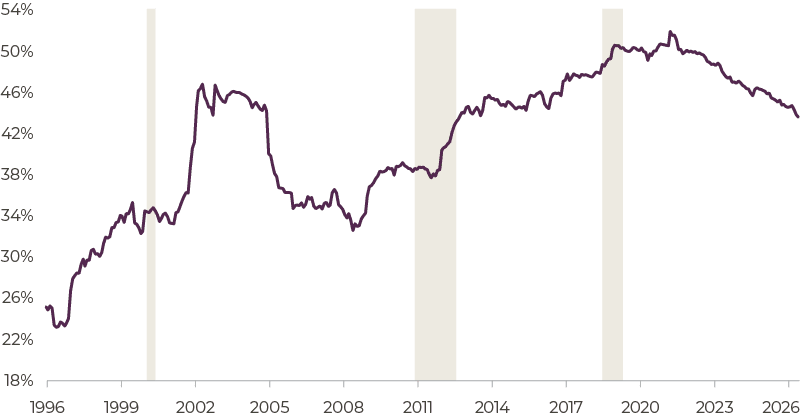
Source: Guggenheim Investments, Barclays, Bloomberg. Data as of 6.30.2026. Grey areas represent recession.
Investors May Be Taking on Undue Credit Risk Within the Agg
Core fixed-income investors with flexibility to deviate from the Agg may tilt heavily toward investment-grade corporate bonds. Within the Agg, exposure to corporates carries a structural bias toward lower quality credit, increasing downgrade risk during economic downturns. BBB-rated bonds have grown from less than 30 percent of the investment-grade universe in the late 1990s to 44 percent of the Bloomberg U.S. Corporate Bond Index today.
While current yields are attractive, credit spreads account for less than 20 percent of all-in yields today, versus a historical average of nearly 30 percent. Across investment-grade corporate ratings, spreads remain near the low end of their historical range, leaving little buffer if growth expectations weaken.
Credit Spreads Are Approaching Historical Tights
A-Rated and BBB-Rated Corporate Bond Option-Adjusted Spreads
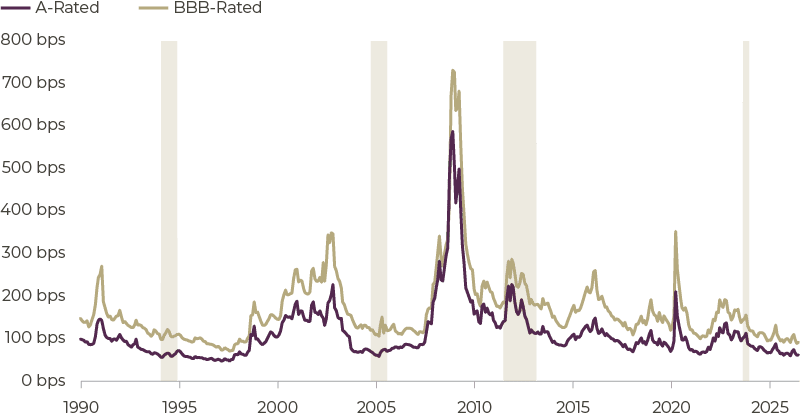
Source: Guggenheim Investments, Bloomberg. Data as of 6.30.2026. Grey areas represent recession.
Elevated Leverage Leaves Credit Issuers More Exposed to a Cycle Turn
Median Gross Leverage, A through BBB-Rated Nonfinancial Corporates
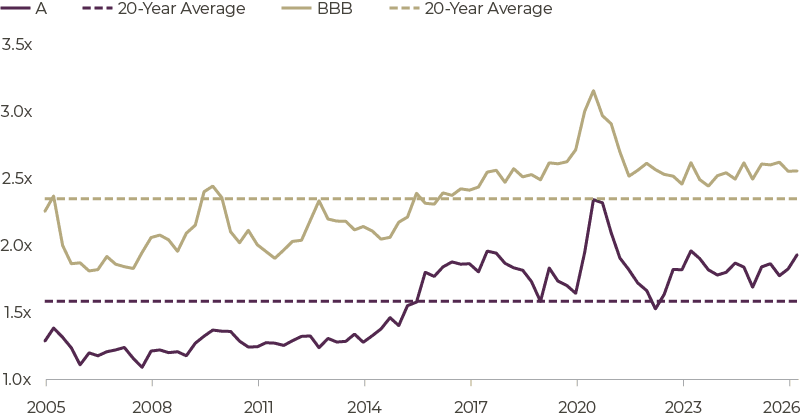
Source: Guggenheim Investments, Bloomberg. Data as of 3.31.2026.
Passive Fixed-Income Investing Remains Dominant
As more investors rely on passive fixed-income strategies, the limitations of benchmark-constrained investing become even more pronounced. We estimate that nearly $3 trillion has flowed into ETFs and passive mutual funds over the past decade, compared with just $584 billion into actively managed equity and taxable bond funds. By design, passive strategies cannot actively manage risks or capitalize on price dislocations when market conditions change. In addition, index-tracking vehicles lock investors into the Agg universe of investments, further concentrating assets in the same benchmark-eligible securities.
This trend warrants caution. While passive vehicles are often favored for perceived liquidity, periods of market stress tend to trigger concentrated outflows. This can exacerbate volatility, forcing asset managers to sell into weakening markets to meet redemptions—creating a structural risk that investors may underappreciate.
We believe actively managed ETFs offer a compelling alternative, particularly in market segments that have historically been difficult to access through traditional fund structures. They combine the liquidity and transparency of the ETF wrapper with the security selection and credit expertise needed to navigate more complex, less commoditized sectors. In our view, active ETFs are a valuable complement to a broader fixed-income allocation, especially as more of the opportunity set sits outside benchmark-eligible securities.
Passive Strategies Are Still Desired by Fixed-Income Investors
Cumulative Net Flows into Taxable Fixed-Income Strategies
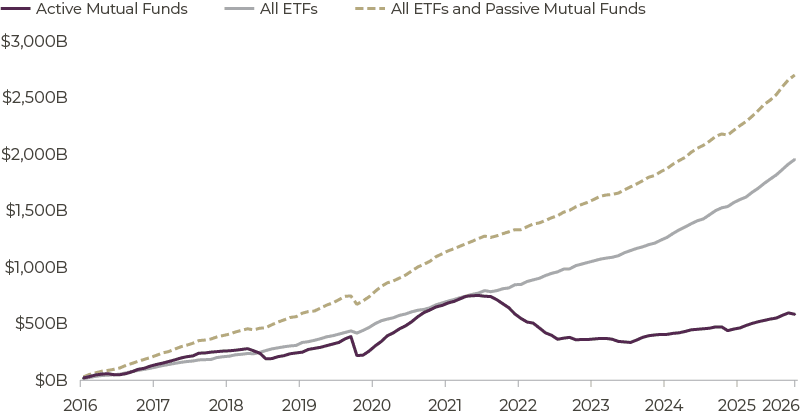
Source: Guggenheim Investments, Morningstar. Data as of 3.31.2026.
SECTION 3
Guggenheim’s Investment Blueprint
At Guggenheim Investments, our disciplined approach combines active management within the benchmark and selective allocations beyond it, while maintaining credit quality. Structured credit, direct lending, CRE loans, and military housing have offered compelling opportunities to enhance diversification, maintain liquidity, and generate attractive yields. But investors must approach these out-of-benchmark allocations with prudence, trusting a manager with deep expertise, relationships, and resources to navigate their unique challenges.
Active Management Is Crucial in a Higher Volatility Regime
Fixed-income returns are rarely consistent from year to year, favoring managers that can capitalize on emerging opportunities. The performance leadership among sectors shifts frequently, with leveraged loans, high yield, investment-grade corporate bonds, and structured credit each taking turns at the top. This rotation creates opportunity for active managers to add value by adjusting allocations across sectors. Capturing that value requires a disciplined and time-tested investment process grounded in research. Of course, there will be periods when the Agg will outperform an active fixed-income manager but, over a cycle, experienced active managers can find opportunity and limit risk in a manner that achieves better results for their clients.
Asset Allocation Matters
Sector Index Returns
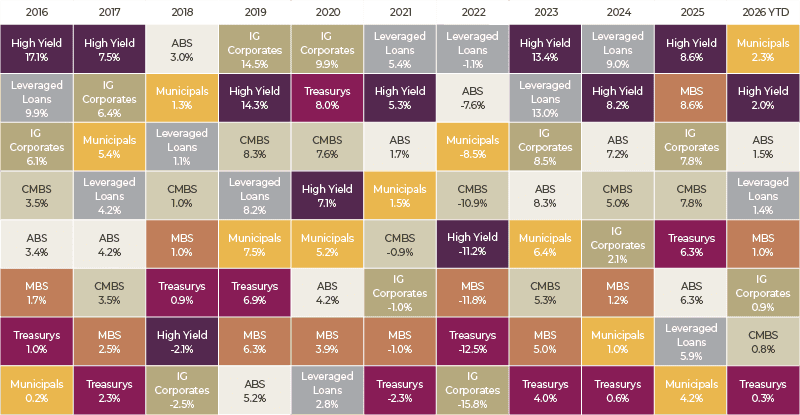
Source: Guggenheim Investments, Bloomberg. Data as of 6.30.2026. Indexes consist of the UBS S&P Leveraged Loan Index, Bloomberg U.S. Corporate High Yield Index, Bloomberg U.S. Treasury Index, Bloomberg Municipals Index, Bloomberg CMBS Investment-Grade Index, ICE BofA AA-BBB ABS Index, Bloomberg U.S. Mortgage-Backed Securities Index. Performance displayed represents past performance, which is no guarantee of future results. Performance will vary over different market cycles. Index information is provided for illustrative purposes only and is not meant to represent the performance of a fund. Referenced indices are unmanaged and not available for direct investment. Index returns do not reflect any management fees, transaction costs or expenses.
Finding Value Beyond the Benchmark in Specialized Credit
The fixed-income landscape in 2026 presents some of the most attractive opportunities in decades, but also significant challenges. While traditional benchmarks like the Agg may not fully capture the breadth of possible fixed-income investment opportunities, a diversified and active approach can help unlock returns by investing across the fixed-income spectrum, including sectors not included in the Agg. With the chasm between investors’ income targets and benchmark yields likely to persist, traditional views of core fixed-income management need to evolve. In our view, investors must be willing to look beyond the benchmark to explore sectors in which value remains underexploited. These sectors are varied and complex, requiring significantly more credit and risk management expertise, ongoing diligence, and deep deal sourcing relationships, but we believe it offers potentially better risk-adjusted returns over time. For established investors like Guggenheim Investments, deep expertise in sourcing structured products and managing credit risk positions our team to potentially generate returns and manage risk across the debt capital structure in a variety of industries.*
Discovering Yield in Structured Credit
Sector Yields vs. Sector Maturity
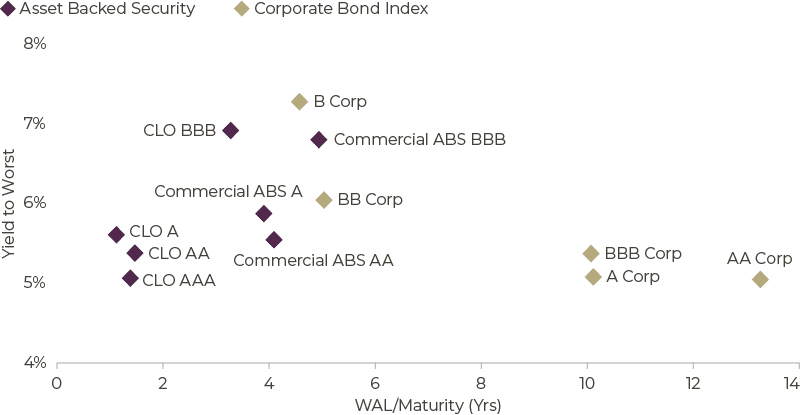
Past performance does not guarantee future results. Source: Guggenheim Investments, Bloomberg. This information is provided for informational purposes only and is intended to reflect the general characteristics of certain fixed-income sectors in the recent market environment. The characteristics shown herein do not represent characteristics of any client portfolios and there is no guarantee that assets with similar characteristics will be available in the future. Corporate bond index data is based on the yield to worst (YTW) and maturities of the AA-, A-, BBB-, BB-, and B-rated sleeves of the Bloomberg U.S. Corporate Bond Index as of 6.30.2026. Collateralized loan obligation (CLO) data is based on the simple yield and weighted average life (WAL) of the J.P. Morgan CLO Index (AAA, AA, A, and BBB) as of 6.30.2026. CLO index yields assume that forward benchmark rates are realized. Commercial ABS information is derived from the aircraft, equipment, railcars, utility, and franchise subsectors of the ICE BofA AA-BBB U.S. Fixed Rate Asset Backed Index as of 6.30.2026, and does not include auto, consumer, student loans, single family rentals, collateralized mortgage obligations, manufactured housing, credit cards, home equity, payment rights, and non-performing loans subsectors. Weighting for the selected commercial ABS universe is based on the current face value in index for the WAL and market value in index for YTW. The subsectors included in commercial ABS are generally issued less frequently, backed by less familiar assets, and potentially higher yielding than those subsectors that are excluded. Because they are less common, they may be more susceptible to liquidity and valuation risk than other ABS subsectors.
Guggenheim Is Well-Positioned to Solve the Core Conundrum
The fixed-income landscape in 2026 presents some of the most attractive opportunities in decades, but also significant challenges. While traditional benchmarks like the Agg may not fully capture the breadth of possible fixed-income investment opportunities, a diversified and active approach can help unlock returns by investing across the fixed-income spectrum, including sectors not included in the Agg. With the chasm between investors’ income targets and benchmark yields likely to persist, traditional views of core fixed-income management need to evolve. In our view, investors must be willing to look beyond the benchmark to explore sectors in which value remains underexploited. These sectors are varied and complex, requiring significantly more credit and risk management expertise, ongoing diligence, and deep deal sourcing relationships, but we believe it offers potentially better risk-adjusted returns over time. For established investors like Guggenheim Investments, deep expertise in sourcing structured products and managing credit risk positions our team to potentially generate returns and manage risk across the debt capital structure in a variety of industries.
Important Notices and Disclosures
*Structured credit, including asset-backed securities (ABS), mortgage-backed securities, and CLOs, are complex investments and not suitable for all investors. Investing in fixed-income instruments is subject to the possibility that interest rates could rise, causing their values to decline. Investors in structured credit generally receive payments that are part interest and part return of principal. These payments may vary based on the rate loans are repaid. Some structured credit investments may have structures that make their reaction to interest rates and other factors difficult to predict, making their prices volatile and they are subject to liquidity and valuation risk. CLOs bear similar risks to investing in loans directly, including credit risk, interest rate risk, counterparty risk and prepayment risk. Loans are often below investment grade, may be unrated, and typically offer a fixed or floating interest rate.
The Bloomberg U.S. Aggregate Bond Index is a broad-based flagship benchmark that measures the investment grade, US dollar-denominated, fixed-rate taxable bond market. The index includes Treasurys, government-related and corporate securities, MBS (Agency fixed-rate and hybrid ARM pass-throughs), ABS, and CMBS (Agency and non-Agency).
The Bloomberg U.S. CMBS Investment-Grade Index measures the market of U.S. Agency and U.S. non-Agency conduit and fusion CMBS deals with a minimum current deal size of $300m.
The Bloomberg U.S. Corporate Bond Index measures the investment grade, fixed-rate, taxable corporate bond market. It includes USD denominated securities publicly issued by U.S. and non-U.S. industrial, utility, and financial issuers.
The Bloomberg U.S. Government Bond Index is comprised of the Bloomberg U.S. Treasury and U.S. Agency Indexes. The index includes USD-denominated, fixed-rate, nominal U.S. Treasurys and U.S. Agency debentures.
The Bloomberg U.S. MBS Index consists of the MBS assets within the Bloomberg Aggregate Index.
The Bloomberg U.S. Municipal Bond Index is a broad-based benchmark that measures the investment grade, USD-denominated, fixed tax-exempt bond market. The index includes state and local general obligation, revenue, insured, and pre-refunded bonds.
The Bloomberg U.S. Treasury Index measures U.S. dollar-denominated, fixed-rate, nominal debt issued by the U.S. Treasury. Treasury bills are excluded by the maturity constraint, but are part of a separate Short Treasury Index. STRIPS are excluded from the index because their inclusion would result in double-counting.
The Bloomberg U.S. Corporate High Yield Bond Index measures the USD-denominated, high yield, fixed-rate corporate bond market. Securities are classified as high yield if the middle rating of Moody’s, Fitch and S&P is Ba1/BB+/BB+ or below.
The ICE BofA U.S. Fixed & Floating Rate Asset Backed Securities Index tracks the performance of USD-denominated investment-grade asset backed securities publicly issued in the US domestic market.
The ICE BofA AA-BBB U.S. Fixed Rate Asset Backed Index is the AA-rated to BBB-rated subset of the ICE BofA U.S. Fixed Rate Asset Backed Securities Index, which tracks the performance of USD-denominated investment-grade fixed rate asset backed securities publicly issued in the U.S. domestic market.
The J.P. Morgan CLO Index tracks the performance of a representative pool of USD‑denominated, broadly syndicated, arbitrage collateralized loan obligations (CLOs).
The S&P UBS Leveraged Loan Index is designed to mirror the investable universe of the USD-denominated leveraged loan market.
Past performance does not guarantee future results.
Investing involves risk, including the possible loss of principal. In general, the value of a fixed-income security falls when interest rates rise and rises when interest rates fall. Longer term bonds are more sensitive to interest rate changes and subject to greater volatility than those with shorter maturities. During periods of declining rates, the interest rates on floating rate securities generally reset downward and their value is unlikely to rise to the same extent as comparable fixed rate securities. High yield and unrated debt securities are at a greater risk of default than investment grade bonds and may be less liquid, which may increase volatility. Investors in asset-backed securities, including mortgage-backed securities and collateralized loan obligations (“CLOs”), generally receive payments that are part interest and part return of principal. These payments may vary based on the rate loans are repaid. Some asset-backed securities may have structures that make their reaction to interest rates and other factors difficult to predict, making their prices volatile and they are subject to liquidity and valuation risk. CLOs bear similar risks to investing in loans directly, such as credit, interest rate, counterparty, prepayment, liquidity, and valuation risks. Loans are often below investment grade, may be unrated, and typically offer a fixed or floating interest rate. Private debt investments are generally considered illiquid and not quoted on any exchange; thus they are difficult to value. The process of valuing investments for which reliable market quotations are not available is based on inherent uncertainties and may not be accurate. Further, the level of discretion used by an investment manager to value private debt securities could lead to conflicts of interest. There is no guarantee that an active manager’s views will produce the desired results or expected returns, which may lead to underperformance. Actively managed investments generally charge higher fees than passive strategies, which could affect performance. In addition, active and frequent trading that can accompany active management, also called “high turnover,” may lead to higher brokerage costs and have a negative impact on performance. Further, active and frequent trading may lead to adverse tax consequences.
This material is distributed or presented for informational or educational purposes only and should not be considered a recommendation of any particular security, strategy or investment product, or as investing advice of any kind. This material is not provided in a fiduciary capacity, may not be relied upon for or in connection with the making of investment decisions, and does not constitute a solicitation of an offer to buy or sell securities. The content contained herein is not intended to be and should not be construed as legal or tax advice and/or a legal opinion. Always consult a financial, tax and/or legal professional regarding your specific situation.
This material contains opinions of the author, but not necessarily those of Guggenheim Partners, LLC or its subsidiaries. The opinions contained herein are subject to change without notice. Forward looking statements, estimates, and certain information contained herein are based upon proprietary and non-proprietary research and other sources. Information contained herein has been obtained from sources believed to be reliable, but are not assured as to accuracy. Past performance is not indicative of future results. There is neither representation nor warranty as to the current accuracy of, nor liability for, decisions based on such information.
Read a fund’s prospectus and summary prospectus (if available) carefully before investing. It contains the fund’s investment objectives, risks, charges, expenses and other information, which should be considered carefully before investing. Obtain a prospectus and summary prospectus (if available) at GuggenheimInvestments.com or call 800.820.0888.
NOT FDIC INSURED | NOT BANK GUARANTEED | MAY LOSE VALUE
© 2026, Guggenheim Partners, LLC. No part of this article may be reproduced in any form, or referred to in any other publication, without express written permission of Guggenheim Partners, LLC. Guggenheim Funds Distributors, LLC is an affiliate of Guggenheim Partners, LLC. For information, call 800.345.7999 or 800.820.0888.
5779059

Portfolio Management Outlook: High Yields, High Quality

Portfolio Management Outlook: Sound Credit Fundamentals and Elevated Yields to Weather Tail Risks to Our Outlook