This Macroeconomic Outlook report is excerpted from the Third Quarter 2026 Fixed-Income Sector Views.
Our baseline view has the Fed on hold into 2027, but with risks to rate hikes.
The U.S. economy enters the second half of 2026 with a steady baseline outlook, but narrow growth drivers and persistent inflation present substantial risks. The economy has weathered a historic energy supply disruption, with tax refunds cushioning consumers from higher energy prices, and AI capex also driving growth. Looking ahead, we expect real gross domestic product (GDP) growth of approximately 2.0 percent in 2026, with a similar pace in 2027. While fiscal support for consumers will fade in coming months, a steadier labor market should help support consumer spending, while upper income consumers in particular continue to benefit from strong wealth gains.
Investment in AI is providing a large and growing impulse to economic growth, with AI capital expenditures projected to contribute around 1 percentage point of real GDP growth during 2026 through direct investment in infrastructure and broad spillovers to activity. Business investment away from the AI infrastructure buildout has been softer, but fiscal provisions should help investment broaden in coming quarters. With growth increasingly reliant on direct spending for the AI buildout and indirect household wealth gains that are supporting consumption, any disruption to the AI investment thesis could present a downside risk to growth.
Inflation remains well above the Federal Reserve’s (Fed) 2 percent target, with core personal consumption expenditures (PCE) inflation at 3.4 percent in the 12 months through May. We expect annual readings will remain above 3 percent for the balance of the year, but sequential monthly prints should moderate in coming months. Tariff effects look to have mostly run their course, and the passthrough of higher energy prices into core inflation should be more benign than feared this spring. However, lingering supply chain disruptions from the Iran conflict could cause some stickiness in inflation, and AI-related technology goods inflation is a new inflationary impulse that has had a notable impact on consumer prices this year. While we expect some moderation in the pace of technology goods inflation, helped by upcoming methodology revisions, this source of inflation poses upside risks.
Despite a more hawkish tone recently from Fed officials, our baseline view has the Fed remaining on hold into 2027 as inflation prints moderate. However, rate hike risks remain elevated if inflation proves persistent. At the Federal Open Market Committee’s (FOMC) June meeting, the Committee signaled that its patience on inflation was wearing thin, with half of participants projecting rate hikes this year. Fed Chair Warsh also communicated a strong commitment to price stability. We ultimately see softer inflation prints in the coming months allowing the Fed to avoid hikes, but we’ll be watching to see if AI-related investment continues to buoy tech-related components, and whether the labor market goes beyond stabilization to renewed tightening.
Inflation Remains Too High, But We Expect Cooler Monthly Readings and a Stable Labor Market Will Keep the Fed on Hold
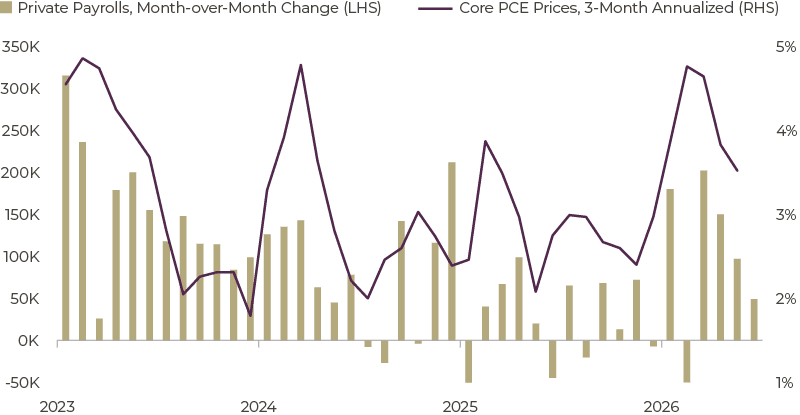
Source: Guggenheim Investments, Haver Analytics, Bureau of Labor Statistics, Bureau of Economic Analysis. Data as of 6.30.2026 for payrolls, 5.31.2026 for core PCE.