/perspectives/macroeconomic-research/growth-resilience-meets-geopolitical-risk

Macroeconomic Update: Growth Resilience Meets Geopolitical Risk
While the U.S. economy remains relatively stable, it is vulnerable to sustained hostilities in the Middle East.
The U.S. economy entered 2026 on reasonably firm footing, with tailwinds from fiscal policy, AI investment, and relatively easy financial conditions. The labor market showed signs of stabilization to start the year, and disinflation looked poised to resume as tariff effects faded.
That narrative has been challenged with the war in Iran and the energy supply shock. Our base case remains that hostilities will ultimately be contained and relatively short-lived, allowing oil prices to trend down from above $100 per barrel to around $80 by year end. In that case, the economic impact should be manageable. This scenario would see a modest hit to growth, a large but temporary spike in headline inflation, and limited passthrough into core consumer prices.
The more concerning scenario involves a prolonged conflict that moves beyond disrupting energy transport and further damages production capacity. While we think it unlikely, in that case, crude prices could remain well above $100 per barrel for several months. The knock-on effects would be significant: a jump in headline inflation that spills over into core inflation, a squeeze on consumer purchasing power, disruptions to global supply chains, and amplification of the shock through tightening financial conditions and a softer labor market. The United States is better insulated than most other countries in this scenario, but it would lead to a meaningfully higher probability of recession.
For now, we expect the economic impacts of the war to be moderate. Real GDP growth in 2026 is expected to be around 2 percent, with tax cuts cushioning the hit to consumers from higher gas prices, and AI capital expenditure (capex) generating a sizable impulse to growth. The labor market remains a watchpoint. While unemployment has leveled off, hiring rates are historically subdued. This thin buffer means even a modest uptick in layoffs could mean a quick rise in the unemployment rate. An intensifying energy shock could be a catalyst for such layoffs, as could disruptive AI impacts.
Year-over-year core personal consumption expenditures inflation is expected to stay sticky this year, driven by hot first quarter readings and near-term impacts from oil passthrough. However, we expect sequential measures will show more disinflation in the second half as tariff and energy impacts fade. The jump in energy prices has generated volatility in expectations for Fed policy, amid conflicting risks to inflation and the labor market. The Fed will likely remain on hold for the next few meetings given the uncertain environment. However, in the second half, we expect fading inflation, along with risks to slower growth and a softer labor market, to ultimately influence Fed policy. We continue to view two rate cuts beginning in the second half of 2026 as the most likely scenario.
Surging Gas Prices Could Eat Away at Consumer Tax Cut Benefits
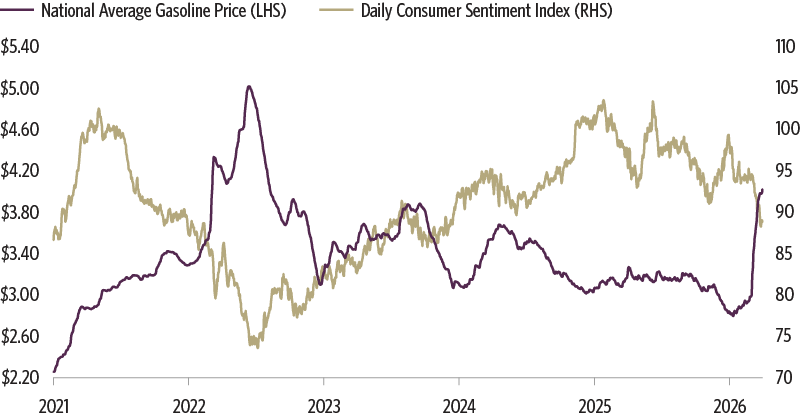
Source: Guggenheim Investments. Bloomberg. Data as of 3.30.2026.
—By Matt Bush and Maria Giraldo
Important Notices and Disclosures
This material is distributed or presented for informational or educational purposes only and should not be considered a recommendation of any particular security, strategy or investment product, or as investing advice of any kind. This material is not provided in a fiduciary capacity, may not be relied upon for or in connection with the making of investment decisions, and does not constitute a solicitation of an offer to buy or sell securities. The content contained herein is not intended to be and should not be construed as legal or tax advice and/or a legal opinion. Always consult a financial, tax and/or legal professional regarding your specific situation.
This material contains opinions of the authors, but not necessarily those of Guggenheim Partners, LLC or its subsidiaries. The opinions contained herein are subject to change without notice. Forward-looking statements, estimates, and certain information contained herein are based upon proprietary and non-proprietary research and other sources. Information contained herein has been obtained from sources believed to be reliable but are not assured as to accuracy. Past performance is not indicative of future results. There is neither representation nor warranty as to the current accuracy of, nor liability for, decisions based on such information.
Investing involves risk, including the possible loss of principal. In general, the value of a fixed-income security falls when interest rates rise and rises when interest rates fall. Longer term bonds are more sensitive to interest rate changes and subject to greater volatility than those with shorter maturities. During periods of declining rates, the interest rates on floating rate securities generally reset downward and their value is unlikely to rise to the same extent as comparable fixed rate securities. Investors in asset-backed securities, including mortgage-backed securities and collateralized loan obligations (“CLOs”), generally receive payments that are part interest and part return of principal. These payments may vary based on the rate loans are repaid. Some asset-backed securities may have structures that make their reaction to interest rates and other factors difficult to predict, making their prices volatile and they are subject to liquidity and valuation risk. CLOs bear similar risks to investing in loans directly, such as credit, interest rate, counterparty, prepayment, liquidity, and valuation risks. Loans are often below investment grade, may be unrated, and typically offer a fixed or floating interest rate.
GPIM 5384055
Tune in to Macro Markets to hear the top minds of Guggenheim Investments offer timely analysis on financial market trends. Guests include portfolio managers, fixed income sector heads, members of the Macroeconomic and Investment Research Group, and more.
Guggenheim Investments represents the investment management businesses of Guggenheim Partners, LLC ("Guggenheim"). Guggenheim Funds Distributors, LLC is an affiliate of Guggenheim.
Read a prospectus and summary prospectus (if available) carefully before investing. It contains the investment objective, risks charges, expenses and the other information, which should be considered carefully before investing. To obtain a prospectus and summary prospectus (if available) click here or call 800.820.0888.
Investing involves risk, including the possible loss of principal.
Guggenheim Investments represents the following affiliated investment management businesses of Guggenheim Partners, LLC: Guggenheim Partners Investment Management, LLC, Security Investors, LLC, Guggenheim Funds Distributors, LLC, Guggenheim Funds Investment Advisors, LLC, Guggenheim Corporate Funding, LLC, Guggenheim Wealth Solutions, LLC, Guggenheim Private Investments, LLC, Guggenheim Investments Loan Advisors, LLC, Guggenheim Partners Europe Limited, Guggenheim Partners Japan Limited, and GS GAMMA Advisors, LLC.
This is not an offer to sell nor a solicitation of an offer to buy the securities herein. GCIF 2019 and GCIF 2016 T are closed for new investments.
©
Guggenheim Investments. All rights reserved.
Research our firm with FINRA Broker Check.
Not FDIC Insured • No Bank Guarantee • May Lose Value
This website is directed to and intended for use by citizens or residents of the United States of America only. The material provided on this website is not intended as a recommendation or as investment advice of any kind, including in connection with rollovers, transfers, and distributions. Such material is not provided in a fiduciary capacity, may not be relied upon for or in connection with the making of investment decisions, and does not constitute a solicitation of an offer to buy or sell securities. All content has been provided for informational or educational purposes only and is not intended to be and should not be construed as legal or tax advice and/or a legal opinion. Always consult a financial, tax and/or legal professional regarding your specific situation. Investing involves risk, including the possible loss of principal.
By choosing an option below, the next time you return to the site, your home page will automatically
be set to this site. You can change your preference at any time.
We have saved your site preference as
Institutional Investors. To change this, update your
preferences.
United States Important Legal Information
By confirming below that you are an Institutional Investor, you will gain access to information on this website (the “Website”) that is intended exclusively for Institutional Investors and, as such, the information should not be relied upon by individual investors. This Website and any product, content, information, tools or services provided or available through the Website (collectively, the “Services”) are provided to Institutional Investors for informational purposes only and do not constitute a recommendation to buy or sell any security or fund interest. Nothing on the Website shall be considered a solicitation for the offering of any investment product or service to any person in any jurisdiction where such solicitation or offering may not lawfully be made. By accessing this Website, you expressly acknowledge and agree that the Website and the Services provided on or through the Website are provided on an as is/as available basis, and except as partnered by law, neither Guggenheim Investments and it parents, subsidiaries and affiliates nor any third party has any responsibility to maintain the website or the Services offered on or through the Website or to supply corrections or updates for the same. You understand that the information provided on this Website is not intended to provide, and should not be relied upon for, tax, legal, accounting or investment advice. You also agree that the terms provided herein with respect to the access and use of the Website are supplemental to and shall not void or modify the Terms of Use in effect for the Website. The information on this Website is solely intended for use by Institutional Investors as defined below: banks, savings and loan associations, insurance companies, and registered investment companies; registered investment advisers; individual investors and other entities with total assets of at least $50 million; governmental entities; employee benefit (retirement) plans, or multiple employee benefit plans offered to employees of the same employer, that in the aggregate have at least 100 participants, but does not include any participant of such plans; member firms or registered person of such a member; or person(s) acting solely on behalf of any such Institutional Investor.
By clicking the "I confirm" information link the user agrees that: “I have read the terms detailed and confirm that I am an Institutional Investor and that I wish to proceed.”