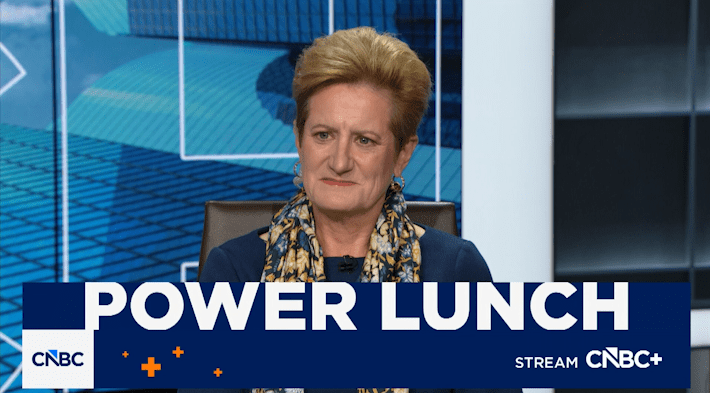
Aaron, let’s get straight to business with your first guest, get her take on the economy, bonds, the markets and more. Joining us for a first on CNBC interview is Dina DiLorenzo. She is President of Guggenheim Investments, with $359 billion in assets across multiple strategies. Dina, it’s great to have you on. Thanks for kicking off the show.
Dina DiLorenzo: Hey Brian.
Brian Sullivan: So I guess the biggest question I’ve got and I’m guessing you’ve gotten as well from your clients is why are the markets holding up so well, when the, I don’t want to call it a war necessarily yet, but there’s still a lot of conflict in the Middle East. Why are we holding up as well as we are?
Dina DiLorenzo: I agree with you, we have geopolitical tension, we’ve got Fed policy uncertainty, we’ve got inflation concerns.
Brian Sullivan: And the stock market’s at record highs.
Dina DiLorenzo: I know, it’s incredible. But here’s the deal: The way we look at it is you’ve got strong balance sheet, strong corporate earnings, AI spending—strong, forward-looking pricing probably already embedded in the markets.
And you know what? There’s a really interesting piece too. I think you know, I grew up on a trading desk in the 90s. You know, there’s emotional volatility. I do think AI is playing a role here. It’s mitigating some of that emotional volatility, and we’re seeing that, right? These AI products are really coming in. Data is processing, investment workflows are reflecting it. And you know, for us, though, as a fixed income global asset manager who really focuses on public and private credit, we do see some volatility, right? And that’s usually the yellow flag the equity markets follow. So, we’re being super cautious and meeting our clients where they are.
Brian Sullivan: It’s an important point you’re making that the credit markets and the bond people will tell you that they’re smarter than the stock people. All you gotta do is ask a bond person they will say that.
Dina DiLorenzo: Well, I’ve played both.
Brian Sullivan: So you’ve played both. Exactly. That’s why we love having you on. In the credit markets, they will tend to crack before the equity markets do for a lot of different reasons. Are you seeing any cracks?
Dina DiLorenzo: I mean, I think it’s selective, and I think you have to choose your managers wisely, right? I mean, I think there was definitely a lot of hype in the first quarter around, you know, the fixed income markets and the credit markets, but the volatility really wasn’t about credit. It was more about the interest rates moving and interest rates going up, and that the fact that the market pushed the expectations of a rate decline out further. So now it’s a matter of making sure that you’re managing duration risk. One, two, you’re managing interest rate risk and you’re managing liquidity risk. We’re seeing a huge amount of demand from our institutional clients still for private credit, and it’s all about underwriting, selection and quality, because that before the war began, that was the worry on Wall Street, was these firms that, let’s be fair, 99 percent of our audience probably had never heard of Blue Owl or those firms or private credit that is now sort of seeped into the global consciousness of the CNBC viewer and listener, yeah, but it’s kind of been pushed to the back pages because of what’s happening around the Persian Gulf and Iran.
Brian Sullivan: Where is private credit right now? Is it the same, better or worse than it was?
Dina DiLorenzo: Let’s take a step back. Private credit is, means multiple things, and I don’t think people really understand that, right? They were focusing on the vehicle that the private credit was in, right? And private credit is still a really important asset class. As a matter of fact, it’s not so much of an alternative now. It’s demanded by both the wealth channel and the institutional channel. It’s an important component of every single portfolio. Single portfolio, right? So private credit is not going away. We’re still seeing a tremendous amount of demand, and there’s different types of private credit. There’s asset-backed financing, there’s CLOs, there’s structured credit, and it’s really important that you choose the right manager to give you a diversified portfolio around private credit that achieves the yield targets that you want and understands what your liquidity needs are. Those are, some of those are sort of scary terms, I imagine for a lot of the non-Wall Street professionals that are watching us.
Brian Sullivan: Yep, right now, what’s your word of advice to the non-pro investor about how to manage through a time which, listen, it’s always a scary, volatile time on Wall Street. If you find a time that isn’t, let me know, and that’s when I’ll be scared, right to be honest with you, because your job is to manage risk. That’s literally your and your team’s job. What’s some words of advice now on how to get through a period where people are like, I don’t understand why the stock markets are record highs?
Well, okay, first, I was formerly a financial advisor before joining Guggenheim, right? And it’s super important that you really understand your client right? You need to understand what their liquidity profiles are, what their long-term goals are. And there’s big difference between institutional and retail clients.
Brian Sullivan: And therapists.
Dina DiLorenzo: Exactly. Yeah. And I think, I think investors are smarter, right, like right now, you do have a little bit of a divergence between investor sentiment and consumer sentiment, and I think it’s really important to understand the difference between the two and really understand that, like overall, it’s important to have a diversified portfolio and really know what’s inside the vehicles that you’re buying and ask the right questions.
Kelly Evans: Dina, it’s Kelly here back in the studio. I appreciate being able to jump in. As I look, talk a little bit more about this in a moment, but things like the 30-year Treasury bond going above 5 percent and some of the trends we’re seeing across shorter maturities. Are those trends that concern you? Is there anything that are these warning signs for fixed income, especially with what’s going on in Japan, or are we making too much of it?
Dina DiLorenzo: Don’t think we should ever make too much of anything right now, right? I think it’s really important to keep fully informed and transparent of what’s happening across the globe, especially as it relates to currencies, oil prices, inflation risk. I mean, we’re entering a phase with a change with the Fed policy potentially. So I think with respect to the way you’re looking at the portfolios for fixed income, it’s really important to make sure that you’re getting the income you need and be positioned in the effect that rates stay flat, go up or go down, and that’s the way that we’re managing the portfolios across the duration risk. So, in just one more on Japan, I don’t know if it is there a message from the country dealing with it’s having to defend the currency. You know, it’s trying everything that’s going on with their bond yields. I can’t help but look there and see it as a precursor, because of debt loads, to maybe what could happen here. But then people have been saying and thinking that for 15 years.
Well, I think you have to keep a really close eye on what’s happening with the oil prices, right? I think that there’s a reaction to the yen right now, because they have to import oil from different places, right? So until we have some transparency on what’s happening with the war and how we’re going to resolve the issues with oil, and where we’re going from here, I think you’re going to see continued volatility.
Brian Sullivan: Yeah. And I think that, to wrap it up, Dina, I think that there’s been a sort of the common wisdom, which sometimes is not very wise, let’s be honest, but the idea that the longer this goes on, the bigger the risks are, the worse it may get. Do you agree with that statement?
Dina DiLorenzo: Well, I think the market has priced in right now that it’s probably going to not resolve itself quickly, right? I think the most important thing is short term spikes and unexpected developments, right? Is there going to be a huge spike, like, is there going to be a huge disruption in the street, where, with the supplies that we’re getting now, are actually going to be even further disrupted? Because I do think that right now, the markets have priced in that the world leaders are, they’re going to resolve this, hopefully, right?
Brian Sullivan: What is the first thing that you check then, every morning you wake up? Is it bond yields? Is it currencies? What is, what’s the first thing you look at?
Dina DiLorenzo: Well, first I check geopolitical news and make sure that overnight, you know what, what has been the safety of the people around the world? I mean, right? I mean, where are people stationed? Where, where are their missiles being shot off, you know, etc. What’s then that impact to the market? What is, what are the world leaders saying? And then, where are the rates going? That’s the second thing I really look at, right? And then, how are the equity markets responding?
Brian: Equities third?
Dina DiLorenzo: Well, because I’m a fixed income, as you said, former trading desk in the 90s, right back when it was, there was a lot of difference in information flow.
Brian Sullivan: But we appreciate you joining us, giving us some of the information that you’re seeing. Real world advice. Dina Lorenzo, kicking things off for us here at the Milken Global Conference. Really appreciate it. Good to see you.
Dina DiLorenzo: Thank you.
Key Takeaways:
Credit market volatility—mainly from rising rates—may be an early warning sign for stocks.
Selecting investment managers skilled in credit underwriting, security selection, and risk management is key to succeeding in volatile markets.
We see demand for private credit, which includes asset-backed finance, CLOs, structured credit, and private debt.
Geopolitical risk, oil prices, rates, and market volatility are variables Guggenheim is watching.

Macro Markets Podcast Episode 89: Beyond the Private Credit Headlines: Finding Opportunity in a Noisy Market

Macro Markets Podcast Episode 88: Halftime Analysis for Investors: Macro Themes and Market Drivers for 2H2026 and Beyond